|
|
|
||||||||||||||||||||||||||||||||||||
|
|
|
Camping in the Wilderness Free translation of an article from Outdoor Magazine - 09/03 dated 14 December 2003 The residents determine the limits of freedom - the rules. And there are more than enough of them in Germany: In Germany, there are approximately 233 people per square kilometer; in Norway, there are only 13. Because of that, in Scandanavian countries, as opposed to the many laws that deal with camping, you can park your tent just about anywhere. If you want to know what is allowed and what is not allowed in Germany, you have to wade through a jungle of paragraphs in the law books. If you call anyone in the German ministry responsible for this subject or members of the hiking and nature preservation clubs whether you are allowed to camp in the countryside, at the end of the phone line, you can expect to hear a deep sigh. Eventually, they will usually come back with the cowardly, but diplomatic phrase, “Well.... that depends!” So, we will try to explain the most important laws in the following paragraphs. In any case, the one rule that always applies to camping legally in the countryside, is that you are allowed to enter the property where you want to camp. And in Germany, this is not regulated consistently throughout the entire country. The Federal Protection Act and the Federal Forest Act both provide a framework for the separate federal states within Germany. The laws regarding entering public lands are found in federal state nature protection laws. To make them easy to follow, there is a set of rules that you can apply to a North-South separation. So in Bavaria, Baden-Wuertemberg, Saarland, and Saxony, you are allowed to enter any property, even unpopulated private property, without the owner’s permission. The exceptions include fields that are used for farming, forestry areas, and other areas that are in use. In the northern federal states, hikers and bikers are limited generally to using trails, dirt roads, and unused land, In other words, you must stay on pathways unless otherwise posted. The individual laws of the federal states can also be further limited by special clauses in each community, which means it is not enough to just look at the laws of the federal states. Theoretically, you have to check the laws in every courthouse in every community to be certain. Camping in open areas, with the exception of forests, is not explicitly forbidden in any federal state. In Germany, the principle of the rights of omission applies, which means, if something is not expressly forbidden, it is allowed. This is different for camping on private land. There, the general rule applies that if you want to sleep on private property, you have to ask the permission of the owner. These are only limited by the rules about entering property mentioned above. Camping in a tent or sleeping under the stars is nothing more than remaining for a short time on the land and, therefore, it is covered only under the laws regarding entering property. Entering property, according to the judges, means only remaining for a short time in a land area. For both expressions, it has to do with so-called undefined terms of law. The line between where remaining for a short time stops and temporarily dwelling on the land begins has to be determined in each individual case. So, ”that depends....” Camping in the woods is another matter. The forests are included in the “out-of-doors”, but there are separate laws for the forests in each federal state. There is a clear definition for a forest: every area of land that is planted with trees, but also areas where trees have been cut down or cleared, forest trails, forest separation areas and security strips, clearings and meadows, wild animal feeding zones, log storage areas, and other areas that belong to a forest, such as moors, fields of heather, and swamps. The laws of each federal state vary, so to be certain, you need to check them all. The same applies for the general behavior regulations. According to these regulations, anyone in a forest area must “behave in such a manner, that the inhabitants of the forest are as undisturbed as possible and the so that the economic use of the forest is not disturbed. Additionally, the “forest may not be endangered, damaged, or spoiled and the peace of others is not disturbed” as stated in the Brandenburg law text. In Baden-Wuertemburg, Berlin, Brandenburg, Hamburg, Lower Saxony, North Rhine Westfalia, Saxony, Saxony-anhalt, tenting in forests is expressly forbidden and requires special permission from the local forestry office. Sleeping in forests without a tent is not regulated in forest protection laws. Tenting in open areas within a forest is in a grey zone of jurisdiction. Whether the campsite is tolerated or not is really up to the forest ranger. They are the noblemen of the forest and you must show them your passport if requested. They also have the right to arrest and detain you. In any case, if you are discovered camping in the wilderness, it is always wise to be polite and not appear to be too self-confident. Outdoor Magazine asked a few forest rangers how they deal with people camping in the forest. Generally, they are very tolerant. Since they are nature-lovers themselves, they tend to be very understanding. As long as you behave orderly, leave nothing behind, and don’t make any open fires, they tend to leave you alone. In a forest ranger’s office in the Eifel, one of the more strict rangers said that sleeping in the woods disturbs the animals. If you meet someone like that, you will have difficulty defending your cause in court, therefore, it is best not to be too assertive. If you want to be securely on the side of the law, ask the forest ranger before you put up your tent. If your campsite is on private property, you need the permission of the owner. Without that permission, you are trespassing, and the owner has the right to drive you away. If you refuse, you can be penalized, and the owner can add all kinds of other charges to persecute you, such as damaging the grass meant for grazing cattle. Instead of trespassing, it is a misdemeanor to camp on public property in open areas without permission. In serious cases, depending on the federal state, you can be fined up to 10,000 Euros. Whether in open areas or in the forest, you are always safe if you have asked for permission. But where? Sometimes, it is very difficult to determine who the owner is or to find him. If there is a town nearby, perhaps you can ask at the town guesthouse or the general store. Usually, it is easy to find the forest ranger’s office. If all else fails, you can go to the land registry office. In areas that are afforded special protection, you don’t need to waste your time asking. The laws for these areas are strict. Camping in national parks, nature protection areas, protected biotopes, wild animal preserves, and water protection areas is strictly forbidden. Even the forest rangers make no exceptions here. In the alpine regions of Switzerland and Austria, camping in the wilderness is also a matter of each local state or canton and the laws there are equally complicated. Additionally, alpine bivouac laws apply. In the Alps, sleeping in bivouac bags and tenting for one night are allowed. Camping in Tirol, on the other hand, includes staying overnight in mobile facilities, such as tents, campers, vehicles, trailers, mobile homes, and other facilities associated with tourism. Bivouac is an exception to camping. In this case, the national park laws, natural reserve laws, and special protection area laws apply. Similar laws apply in Switzerland. In reality, if you are underway out-of-doors, unless you sleep in a nature protection area or in someone’s front lawn, you will rarely see a forest ranger or a farmer. If there is no one to accuse you, there are no consequences. If you are discovered anyway, you are safer sleeping on the ground without a tent than with one. Whether a tarp stretched over a rope is a tent or not isn’t worth the attempt at defending yourself. Whatever the case, any excuse that can be escalated can be counterproductive. It is also nearly impossible to convince someone that you were lost in a German forest and, in an emergency, you were forced to put up a tent. Since you know when it gets dark every day, you can’t be surprised by it. Lying will provoke even tolerant forest rangers. As long as tenting is not regulated equally in every area and no explicit permission has been granted, we can’t recommend camping in the wilderness to anyone. However, if you want to sleep in the wilderness anyway, take a tip from us: above all else, be friendly. And if you really want to take a chance, it is wise to have a little extra money for a good lawyer. |
|
Here’s What the Forest Rangers Say |
|
|
|
From <http://www.outdoor-magazin.com/dassagendiefoerster.38712.htm> |
|
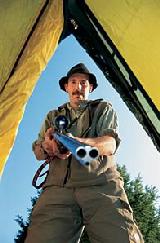
Camping Out-of-Doors: Tips on How to Avoid Problems if you want to camp in the wilderness, get permission of the land owner if you can find him. Sleeping the in the forest is strictly forbidden in many federal states. If you sleep without a tent, that is a grey area, but it is generally allowed. Outlaw-Tips If you are caught, remain polite, friendly, apologize, and do whatever the forest ranger or policeman says. Aggressive or smart remarks will guarantee that you get a worse punishment than if you are polite. Hunting Times Wild Animals Open Fires Fines |
|
|
|
|
||||||||||||||||||||||||